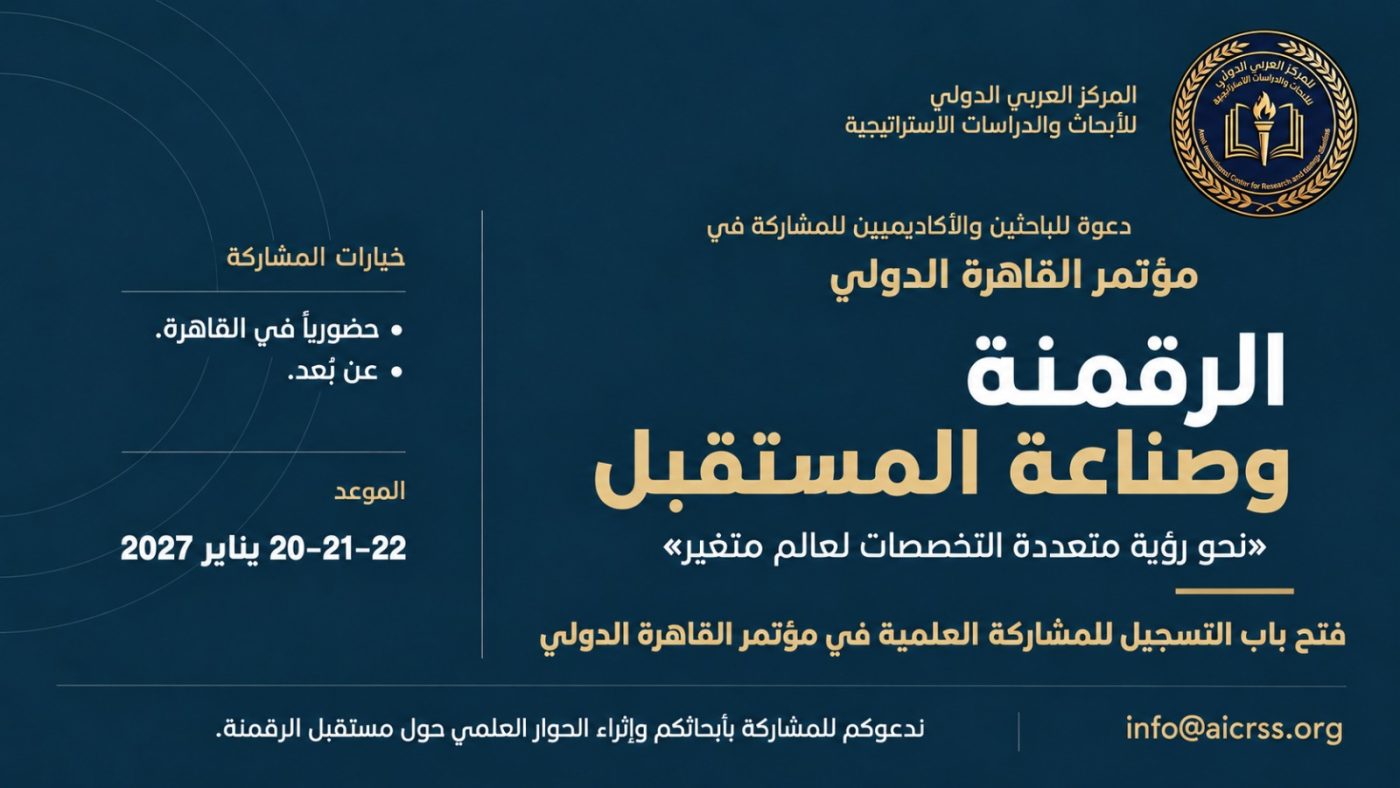
The Arab International Center for Research and Strategic Studies is now accepting research abstracts for the Cairo International Conference, “Digitalization and the Making of the Future: Towards an Interdisciplinary Vision for a Changing World,” to be held in Cairo, Egypt, from January 20–22, 2027, with both in-person and online participation options. The conference features eight scientific themes covering media, artificial intelligence, economics, education, healthcare, law, humanities, and natural sciences. The deadline for abstract submissions is November 15, 2026.
Arab International Center for Research and Strategic Studies Announces the Themes of the Cairo International Conference “Digitalization and the Making of the Future”
Cairo to Host an International Multidisciplinary Conference in January 2027, Welcoming Researchers and Academics In Person and Online
The Arab International Center for Research and Strategic Studies has announced the opening of abstract submissions for the Cairo International Conference “Digitalization and the Making of the Future: Towards an Interdisciplinary Vision for a Changing World,” scheduled to take place in Cairo, Egypt, on January 20–22, 2027.
The conference welcomes researchers, academics, postgraduate students, professionals, and interested participants from a wide range of scientific, humanities, applied, and social science disciplines. Participation will be available both in person in Cairo and online.
The conference aims to promote academic dialogue on accelerating digital transformations, explore the potential of artificial intelligence and technology in advancing knowledge and professional practices, and examine the implications of these developments for the future of individuals, institutions, and societies. It also seeks to foster interdisciplinary approaches and encourage the exchange of expertise, ideas, and forward-looking perspectives.
Eight Scientific Themes Covering a Broad Range of Disciplines
The conference features eight principal scientific themes, reflecting the growing impact of digitalization across different fields and providing opportunities for researchers to submit specialized, interdisciplinary, and multidisciplinary studies addressing digital transformation, its applications, challenges, and future prospects.
The themes are as follows:
1. Digitalization, Geopolitical Transformations, and the International Order
This theme examines geopolitical shifts in the age of artificial intelligence, international relations and digital diplomacy, global competition over technology and data, national security and digital sovereignty, and political and strategic transformations in the international system.
2. Management, Economics, Governance, and Institutional Transformation
This theme addresses digital transformation in public and private institutions, strategic management, leadership and digital governance, public administration and e-government, public policy, the digital economy, smart markets and e-commerce, digital accounting and finance, entrepreneurship, innovation, human resource management, project management, supply chains, institutional development, and decision-making.
3. Artificial Intelligence, Computer Science, and Advanced Technology
This theme focuses on generative artificial intelligence and its interdisciplinary applications, computer science, software engineering and algorithms, data science and big data analytics, cybersecurity and information protection, robotics, the Internet of Things, cloud computing, digital engineering, smart manufacturing, automation, technological innovation, and smart cities.
4. Media, Communication, Humanities, and Social Sciences
This theme explores digital media, journalism and mass communication, artificial intelligence in media and public relations, public opinion, media disinformation and fact-checking, social and psychological transformations in digital environments, political science, strategic communication, language, literature, translation, cultural studies, digital identity, digital citizenship, youth, the digital divide, philosophy, ethics, and intellectual transformations in the digital age.
5. Education, Pedagogy, Scientific Research, and Knowledge Innovation
This theme addresses digital transformation in school and higher education, artificial intelligence in teaching and assessment, e-learning and distance education, curricula and teaching methods, special education, educational leadership and administration, digital libraries and archiving, research methodologies and digital data analysis, research ethics and academic publishing in the age of artificial intelligence, digital skills development, and lifelong learning.
6. Health, Medical, and Life Sciences
This theme covers artificial intelligence in diagnosis and treatment, precision medicine, digital health and telemedicine, nursing and allied health sciences, public health and epidemiological data analysis, pharmacy, biotechnology and pharmaceutical innovation, medical laboratories, modern diagnostic technologies, healthcare management, quality of care, health informatics, medical data ethics, and biological and life sciences.
7. Law, Legislation, Ethics, and Human Rights
This theme examines legislation governing artificial intelligence and emerging technologies, digital law, cybercrime and digital evidence, privacy and data protection, intellectual property, legal responsibility for decisions made by intelligent systems, human rights and civil liberties in digital environments, technology ethics, digital justice, international law, technology regulation, governance, anti-corruption, transparency, and accountability.
8. Natural, Engineering, Environmental, and Agricultural Sciences and Sustainable Development
This theme encompasses mathematics, statistics, computational modeling and simulation, physics, chemistry, materials science, engineering disciplines, renewable energy and energy efficiency, climate change, natural resource and water management, smart agriculture, food security, agricultural biotechnology, Earth sciences, geology, urban planning, smart cities, transportation, tourism, archaeology, cultural heritage and digitalization, marine and environmental sciences, ecosystem management, sustainable development, the green economy, social innovation, interdisciplinary studies, and future studies examining human–machine interaction.
Research Participation and Academic Publishing Opportunities
The conference welcomes theoretical and applied research, as well as case studies from a wide range of scientific, humanities, social science, and professional disciplines. Particular emphasis is placed on interdisciplinary and multidisciplinary contributions that offer innovative perspectives on digitalization, artificial intelligence, innovation, and future transformations.
According to the conference announcement, submitted abstracts and research papers will undergo scientific evaluation in accordance with the applicable academic criteria. Accepted papers may be published in a dedicated conference proceedings volume, subject to the scientific review, formatting, and publication requirements established by the scientific committee.
The conference will also provide an opportunity to nominate outstanding research papers that meet the required academic standards for publication in peer-reviewed journals indexed in the Scopus database. Actual publication will remain subject to each journal’s editorial policies, peer-review procedures, and acceptance criteria.
To qualify for consideration, research must demonstrate originality and novelty, follow clear scientific and methodological principles, and comply with academic integrity and proper citation standards.
Researchers are required to submit an abstract containing the research title, problem statement, objectives, methodology, anticipated key findings, and keywords. Abstracts must not exceed 300 words, unless otherwise specified by the scientific committee.
November 15, 2026: Deadline for Abstract Submissions
The Arab International Center for Research and Strategic Studies invites researchers, academics, and interested participants to submit their research abstracts by November 15, 2026, for evaluation by the conference scientific committee.
Submissions and inquiries may be sent to the official conference email address:
Researchers should include the following information in their submissions:
-
Full name.
-
Academic or professional title.
-
Affiliated institution or university.
-
Field of specialization.
-
Research title and abstract.
-
Email address.
-
Contact number.
-
Preferred mode of participation.
For further information about the conference, its scientific themes, and participation requirements, please visit the Center’s official website at www.aicrss.org or contact the organizers via WhatsApp at +970 598 122 060.
The conference reflects the Center’s commitment to advancing scientific research and interdisciplinary academic dialogue, providing a platform for the exchange of knowledge and expertise on accelerating digital transformations, and developing forward-looking perspectives on the future of technology and society in a changing world.
For inquiries and research submissions:
Email: info@aicrss.org
Website: www.aicrss.org
Arab International Center for Research and Strategic Studies
← News